

For women considering breast lift surgery, one question tends to come up early: “Do I also need an implant?” Not necessarily. The answer depends on breast anatomy, the amount of existing tissue and the degree of sagging, but silicone implants are not the only way to reshape a breast or address lost fullness.
Implant-free breast lifting can reshape existing tissue to restore upper-pole fullness while preserving the breast’s natural tissue and feel.
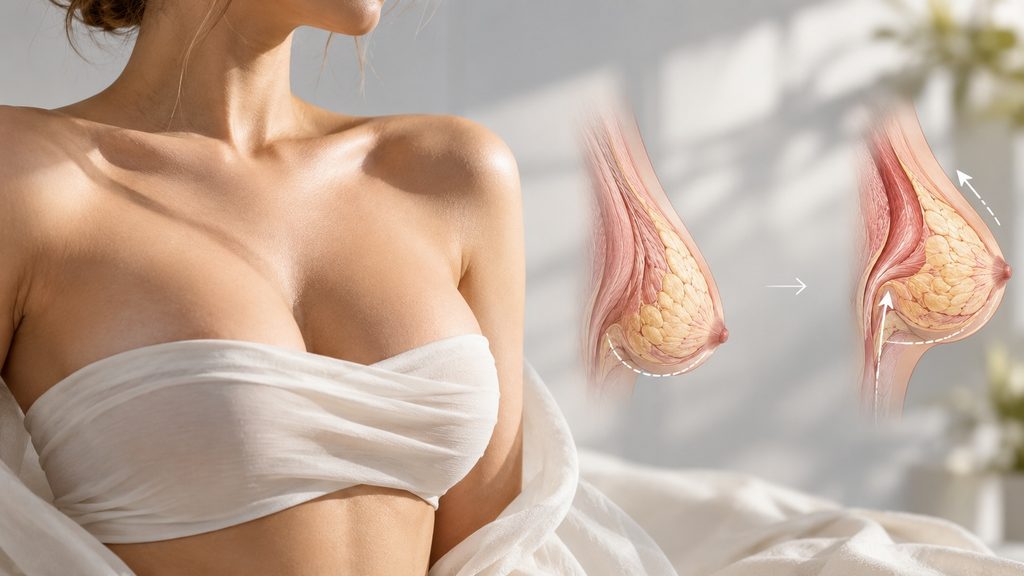
Modern mastopexy can go beyond removing excess skin and repositioning the nipple. In selected patients, the breast tissue itself can be reshaped and moved to a more useful position. Instead of adding volume through a foreign material, the surgeon works with tissue the patient already has.
Table of Contents
How Does an Implant-Free Breast Lift Work?
A breast lift, or mastopexy, primarily addresses breast ptosis, the medical term for sagging. Depending on the patient’s anatomy, surgery may involve removing excess skin, reshaping the breast envelope and repositioning the nipple-areola complex. There is no single surgical plan that fits every breast.
Where implant-free techniques become particularly interesting is in the handling of existing tissue. Tissue in the lower part of a sagging breast does not always have to be treated simply as excess. With certain autoaugmentation techniques, it can be reshaped and repositioned so that it contributes to the new breast contour.
What Does Using Your Own Breast Tissue Actually Mean?
“Using your own tissue” can be misleading if it is interpreted as creating new breast volume. It does not. The surgeon is working with a finite amount of tissue, so how much tissue is already present matters.
What can change is the distribution of that volume. If enough tissue is concentrated in the lower part of the breast, some techniques allow it to be repositioned higher and used to support a fuller contour. The aim is not to manufacture volume, but to make different use of what is already there.
Can Upper-Pole Fullness Be Created Without Implants?
Yes, in suitable patients it can. The upper pole is the area above the nipple, and loss of fullness there is common after pregnancy, breastfeeding, significant weight changes and ageing. That flatter upper contour is often what leads someone to assume that an implant will be necessary.
Autoaugmentation offers another possibility. Existing breast tissue can be repositioned toward the upper breast to change how the available volume is distributed. There is, however, a natural limit: the result depends on the amount and quality of tissue available in the first place.
What Is Autoprosthesis in Breast Surgery?
Autoprosthesis describes the use of a patient’s own tissue as an internal source of shape, volume or support rather than placing a conventional prosthesis. In breast surgery, the idea is closely related to techniques described as autoaugmentation or autologous tissue reshaping.
Put more simply, the breast’s own tissue takes on part of the shaping role that people often associate with an implant. It is repositioned strategically rather than replaced by an artificial source of volume.
There is an important distinction here. An autoprosthesis does not turn a breast lift into conventional breast augmentation, and it cannot provide an unlimited increase in size. Its purpose is to use the available natural tissue more effectively.
How Does Dual-Plane Autoprosthesis Differ?
Own-tissue breast lift techniques do not all follow the same surgical plan. One approach involves reshaping tissue from the lower breast and moving it into a subpectoral plane, allowing the pectoral muscle to contribute to its support.
This principle is used in the Autoprosthesis approach described with the Dual-Plane Autoprosthesis technique. Here, native breast tissue is reshaped and repositioned rather than replacing lost upper-pole fullness with a silicone implant.
For someone researching the procedure, the terminology is less important than understanding where the new contour actually comes from. In this approach, the volume comes from the patient’s existing breast tissue.
Why Does the Position of the Tissue Matter?
Moving tissue upward and creating internal support are not quite the same thing. Surgical techniques vary in the way tissue is shaped, positioned and supported, and those details influence the contour the operation is intended to create.
With a dual-plane approach, repositioned tissue works across more than one anatomical plane. In particular, the pectoral muscle is used as part of the support strategy when creating upper-pole fullness from existing tissue.
What Are the Potential Advantages of Implant-Free Breast Aesthetics?
The most obvious difference is straightforward: no silicone prosthesis remains inside the breast. For a patient who specifically wants to avoid a foreign material, that alone may be relevant when discussing surgical options.
There are several other differences to consider:
- The surgeon reshapes the breast using the patient’s existing natural tissue.
- There is no silicone implant that may later need to be exchanged.
- Implant rupture is not applicable because no breast implant is present.
- Capsular contracture around an implant is likewise not an implant-related concern in an implant-free procedure.
- The volume used for reshaping consists of the patient’s own breast tissue.
That does not mean implant-free surgery is automatically a better choice than implant-based surgery. The two approaches do not necessarily solve the same problem. Someone looking for a substantial increase in breast size, for instance, may be asking for more volume than her existing tissue can provide.
Who May Be Suitable for an Own-Tissue Breast Lift?
The amount of available breast tissue matters a great deal. There needs to be enough tissue to reshape before that tissue can make a meaningful contribution to upper-pole volume. A patient with pronounced ptosis and adequate natural breast tissue starts from a very different position than someone with a small breast and little tissue available for redistribution.
An own-tissue approach may be considered when there is:
- moderate or more pronounced breast sagging;
- sufficient natural breast tissue to work with;
- volume loss after pregnancy, breastfeeding or changes in body weight;
- a preference for avoiding silicone implants;
- a realistic expectation of how much fullness existing tissue can provide.
This is not a checklist that can confirm candidacy without an examination. Breast dimensions, tissue distribution, skin quality, previous surgery and the shape a patient hopes to achieve all affect the decision.
Implant or Own Tissue: What Is the Real Difference?
The simplest difference is the source of the volume. An implant introduces additional volume that was not there before. An autoprosthesis approach works by redistributing volume the patient already has.
That makes the desired outcome a better starting point than asking which method is “better.” Is the main concern sagging? Is more upper-pole fullness the priority? Does the patient want a significant increase in overall breast size, or would she prefer to preserve her existing volume while changing its shape and position?
If enough natural tissue is present and the aim is primarily lifting and redistribution, an implant-free technique may be worth discussing. When there is little existing tissue but a substantial size increase is desired, the possibilities and limitations are different.
Questions Worth Asking Before Choosing a Technique
Before deciding on a procedure, it makes sense to establish what can realistically be achieved with the anatomy you have. Existing breast volume, degree of ptosis, the desired upper-pole contour and expectations regarding final breast size all belong in that discussion.
There are practical questions too. Where will the tissue be positioned? How will it be supported internally? What scars should you expect? And how might ageing, pregnancy or future weight fluctuations change the result? Answers to these questions are usually more informative than the name of the operation alone.
What Does Noimplant Breast Aesthetics Really Mean?
“No implant” sounds self-explanatory, but it describes what is absent rather than explaining what the surgeon actually does. Several surgical methods may avoid silicone while handling the patient’s tissue in very different ways.
When researching Implant-Free Breast Aesthetics, it is useful to look past the label and examine the surgical principle. Where does the fullness come from? How is the tissue supported? Who is considered a suitable candidate? Has the technique been described in clinical research? These questions reveal much more than before-and-after photographs on their own.
The limitations deserve the same attention. A breast lift cannot prevent natural tissue from changing with ageing, gravity, pregnancy or substantial fluctuations in body weight. Implant-free means that an implant is not used; it should not be read as risk-free or as a promise that the breast will never change again.
PureOwn and the Own-Tissue Approach to Breast Reshaping
pureown focuses specifically on this area through the Zereyak Dual-Plane Autoprosthesis technique, an implant-free approach intended to combine breast lifting with upper-pole fullness. The technique reshapes lower-pole breast tissue and positions it within a subpectoral plane, allowing the patient’s own tissue to provide volume while the pectoral muscle contributes support.
The technique is associated with plastic surgeon Dr. Umut Zereyak and has been described in a peer-reviewed publication in Aesthetic Plastic Surgery. For patients researching a less familiar surgical approach, that clinical context matters: it gives them something more concrete to examine than promotional terminology or photographs alone.
Even then, candidacy remains individual. A technique that relies on existing tissue needs enough suitable tissue to work with. Whether a patient’s anatomy and expectations match what the procedure is designed to achieve can only be determined through a proper medical assessment.
What About Scars, Recovery and Long-Term Changes?
Implant-free does not mean incision-free. This remains breast lift surgery, so scars are expected. Their extent and position vary according to the degree of ptosis, breast anatomy and the surgical technique used.
Recovery is individual as well. Swelling, discomfort, temporary changes in sensation and restrictions on physical activity can occur after breast surgery. Although a change in breast shape may be visible relatively early, the tissues need considerably more time to settle and mature.
Then there is the longer term. Natural breast tissue stays biologically active and continues to respond to ageing, gravity, hormonal changes, pregnancy and body-weight fluctuations. No mastopexy can responsibly be presented as a guarantee that the breast will remain unchanged for life.
Is Implant-Free Breast Lifting the Right Direction for You?
If avoiding silicone is a priority, there may be more than one way to approach breast reshaping. Existing tissue can sometimes become an active part of the lift, rather than simply being preserved or removed.
But “in suitable patients” is the part that should not be overlooked. Available tissue sets a natural boundary on what can be achieved, and two women with different breast anatomy should not expect the same result from the same technique.
A useful next step is therefore to understand how the operation works before choosing it on the basis of terminology or photographs. Be clear about the result you want, understand where the proposed volume will come from and discuss whether your anatomy can realistically support that goal.
Frequently Asked Questions About Implant-Free Breast Aesthetics
1. Can breasts really be lifted without implants?
Yes. A mastopexy does not inherently require a breast implant. Excess skin can be removed, existing tissue reshaped and the breast repositioned without adding a prosthesis. Some techniques also use the patient’s own tissue to improve upper-pole fullness.
2. Can an implant-free breast lift make breasts look fuller?
It can make better use of existing volume by changing where that tissue sits. This may create more fullness in areas such as the upper breast, but it does not generate unlimited new volume. The result is constrained by the amount of tissue already available.
3. What is breast autoaugmentation?
Breast autoaugmentation generally means reshaping and repositioning a patient’s own breast tissue to improve contour or fullness during a lift, rather than relying solely on an implant for volume.
4. What does autoprosthesis mean?
In breast surgery, autoprosthesis refers to using the patient’s own tissue as an internal source of volume, shape or support. Instead of inserting a silicone device to provide that volume, native tissue is reshaped and repositioned.
5. Is an implant-free breast lift suitable for very small breasts?
Not in every case. If there is very little breast tissue, there may not be enough volume available to redistribute and create the desired fullness. Cup size alone cannot determine this; the tissue has to be assessed clinically.
6. Does an implant-free breast lift leave scars?
Yes. Breast lifting requires surgical incisions, and scars are part of the procedure. The scar pattern and length depend on the patient’s anatomy and how much lifting and reshaping are necessary.
7. Can upper-pole fullness be achieved without silicone?
Yes, for appropriately selected patients. Existing breast tissue can be repositioned toward the upper breast to improve fullness there. How much can be achieved varies with anatomy, available tissue and the technique used.
8. Can breasts sag again after a lift?
They can change over time. A breast lift reshapes the breast at the time of surgery, but it cannot stop ageing, gravity, pregnancy, breastfeeding or weight changes from affecting natural tissue later.
Complications that depend on an implant being present, such as implant rupture or capsular contracture around a breast implant, do not apply when no implant is inserted. The operation still carries the general risks associated with breast surgery.
10. Does using your own tissue mean the procedure is risk-free?
No. Using native tissue avoids issues that are specific to an implant, but surgery itself still involves risks related to anaesthesia, healing, scarring, sensation and other potential complications that should be discussed with the treating surgeon.
11. How do I know whether I have enough breast tissue for autoaugmentation?
You cannot determine that reliably from bra or cup size. A surgeon needs to assess the amount and distribution of tissue, breast dimensions, skin quality and degree of ptosis before deciding whether there is enough tissue to reposition.
12. Is an own-tissue breast lift the same as breast augmentation with implants?
No. Implant augmentation adds volume through a prosthetic device. An own-tissue breast lift primarily reshapes and redistributes volume that already exists, so the two procedures have different possibilities and natural limitations.
What is your reaction to this?
 I liked it
 Wonderful
 Thanks
 Good
Good Hahaha !
 Incredible
 Interesting
 Wrong
Wrong
