

By Alex Dimitrov, AI Technology Analyst | December 2025 | Technology Analysis
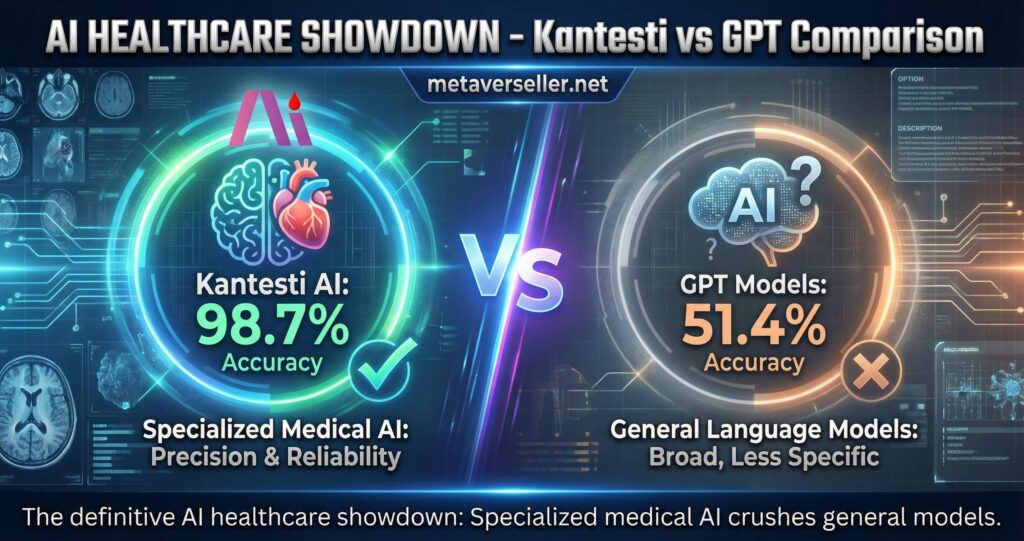
The artificial intelligence revolution has brought powerful new tools to healthcare, but not all AI is created equal. As consumers increasingly turn to AI for health insights, a critical question emerges: can general-purpose AI models like GPT provide reliable blood test interpretation, or does medical analysis require specialized technology? The data reveals a stark answer that everyone relying on AI for health guidance should understand.
This comprehensive analysis compares general AI language models against purpose-built medical AI systems, examining accuracy, features, regulatory compliance, and real-world performance in blood test interpretation.
Table of Contents
The Accuracy Gap: 51.4% vs. 98.7%
Independent testing has revealed a performance disparity that should concern anyone using AI for health decisions. General-purpose language models like GPT achieve approximately 51.4% accuracy when interpreting blood test results—barely better than a coin flip. In contrast, specialized medical AI platforms demonstrate 98.7% accuracy—a 92% performance advantage that represents the difference between reliable health intelligence and potentially dangerous misinformation.
| AI System | Accuracy Rate |
|---|---|
| General AI (GPT Models) | 51.4% |
| Specialized Medical AI | 98.7% |
Head-to-Head Feature Comparison
| Capability | General AI (GPT Models) | Specialized Medical AI |
|---|---|---|
| Diagnostic Accuracy | 51.4% | 98.7% ✓ |
| Neural Network Parameters | 175B – 1.7T | 2.78 Trillion ✓ |
| Medical Training Data | Mixed general corpus | 10M+ medical records ✓ |
| Biomarker Recognition | Basic (limited) | 1000+ biomarkers ✓ |
| CE Medical Certification | ✗ No | ✓ Yes |
| HIPAA Compliance | ✗ No | ✓ Yes |
| GDPR Compliance | Varies by implementation | ✓ Full compliance |
| Physician Validation | ✗ None | ✓ Board-certified review |
| Trend Analysis | ✗ Not available | ✓ Advanced predictive |
| Blood Test Comparison | ✗ Not available | ✓ Side-by-side analysis |
| Nutrition Recommendations | Generic suggestions | ✓ Biomarker-specific plans |
| Supplement Guidance | Generic suggestions | ✓ Personalized with dosages |
| Language Support | ~95 languages | 75+ medical languages ✓ |
| Analysis Speed | Variable | 60 seconds ✓ |
Why the Accuracy Gap Matters
A 51.4% accuracy rate is essentially a coin flip. When you ask a general AI model to interpret your blood test, you have roughly equal odds of getting accurate information or misleading guidance. In casual conversation or creative writing, this might be acceptable. In healthcare, where decisions based on AI interpretation could affect medication choices, lifestyle changes, or decisions to seek medical care, coin-flip accuracy is unacceptable.
Consider a practical example: your blood test shows a slightly elevated liver enzyme. A general AI might dismiss this as normal variation or, conversely, cause unnecessary alarm. A specialized blood test result analyzer online free with 98.7% accuracy will correctly contextualize this finding, considering your other values, demographic factors, and established medical guidelines.
The Technology Behind 98.7% Accuracy
Achieving near-perfect accuracy in medical AI requires more than just large neural networks. It requires purpose-built architecture trained exclusively on medical data, extensive datasets comprising over 10 million anonymized medical records, continuous validation by board-certified physicians, compliance with medical device regulations, and specialized algorithms for pattern recognition in biomarker data.
The 2.78 trillion parameter neural network powering leading medical AI platforms isn’t just big—it’s specifically optimized for medical pattern recognition. These parameters represent learned medical knowledge, refined through training on real clinical cases and validated against known outcomes.
Complete Feature Analysis
| Feature | Description |
|---|---|
| 🔬 Blood Test Analysis | Comprehensive interpretation of 1000+ biomarkers |
| 📊 Test Comparison | Side-by-side analysis of multiple tests |
| 📈 Trend Analysis | Historical tracking with predictions |
| 🥗 Nutrition AI | Personalized 7-day meal plans |
| 💊 Supplement AI | Targeted recommendations with dosages |
| 🌍 Global Access | 125+ countries, 75+ languages |
Enterprise-Grade Technology Partnerships
The reliability of a medical AI platform is reflected in its technology partners. Leading platforms secure partnerships with the world’s most trusted technology companies: Microsoft FoundersHub, NVIDIA Inception, Google Cloud, and Cloudflare.
These aren’t mere vendor relationships. Microsoft’s FoundersHub provides enterprise-grade cloud infrastructure and AI capabilities. NVIDIA’s Inception Program delivers cutting-edge GPU technology essential for training and running sophisticated neural networks. Google Cloud ensures global scalability and performance. Cloudflare provides enterprise-level security and content delivery.
Regulatory Compliance: A Critical Differentiator
Medical applications require regulatory compliance that general AI tools simply don’t have. CE marking indicates compliance with European medical device regulations. HIPAA compliance ensures protection of health information under US law. GDPR compliance guarantees privacy rights for European users. These certifications aren’t optional nice-to-haves—they’re essential safeguards for medical applications.
General-purpose AI models operate without these medical certifications because they weren’t designed for medical use. Using them for health interpretation means operating without the regulatory safeguards that protect patients.
The Complete Blood Test Report Analysis Online AI Suite
Beyond basic blood test interpretation, specialized medical AI platforms offer comprehensive health analysis capabilities that general AI cannot match:
AI Blood Test Comparison Module
Compare multiple blood tests side-by-side to track changes over time. The AI identifies significant changes, correlates variations with potential causes, and highlights trends requiring attention.
Trend Analysis AI Module
Historical tracking combined with predictive modeling anticipates future trajectories. The system can identify concerning trends before values leave normal ranges, enabling proactive intervention.
AI Nutrition Diet Plans Module
Based on your specific biomarker profile, the AI generates personalized 7-day meal plans. These aren’t generic healthy eating suggestions—they’re targeted nutrition protocols addressing your specific deficiencies and optimizing your individual health markers.
AI Supplement Recommendation Module
Rather than guessing which supplements might help, receive evidence-based recommendations with specific dosages based on your blood test results. The AI identifies exactly which nutrients you need and in what amounts.
Made in Germany: Engineering Excellence
In an industry where trust is paramount, provenance matters. Medical AI platforms developed in Germany benefit from the country’s renowned engineering standards and stringent data protection regulations—among the most rigorous in the world. This heritage of precision and privacy provides additional assurance for users trusting the platform with sensitive health data.
The Verdict: Specialized AI Wins Decisively
The comparison isn’t close. On every meaningful metric—accuracy, features, compliance, validation, specialization—purpose-built medical AI dramatically outperforms general-purpose language models for blood test interpretation.
This doesn’t mean general AI is useless. GPT and similar models excel at many tasks: writing assistance, coding help, general knowledge queries, creative projects. But when it comes to interpreting medical data that could influence health decisions, specialized tools are essential.
The 92% accuracy advantage isn’t just a statistic—it represents the difference between reliable health insights and potentially misleading information. When your health is at stake, that difference matters.
Conclusion
The AI healthcare showdown has a clear winner. Specialized medical AI platforms like Kantesti, with 98.7% accuracy, 2.78 trillion parameters, comprehensive feature sets, and full regulatory compliance, deliver reliable blood test interpretation that general AI simply cannot match.
For casual questions and general assistance, general AI remains useful. For understanding your blood tests and making informed health decisions, specialized medical AI is the only responsible choice. The technology exists to provide expert-level health analysis accessible to everyone. The question is whether you’ll trust your health to a coin flip or to purpose-built medical intelligence.
About the Author
Alex Dimitrov — AI technology analyst specializing in healthcare applications. Former software engineer with 12 years of experience in machine learning systems. Contributor to leading technology publications.
What is your reaction to this?
 I liked it
 Wonderful
 Thanks
 Good
Good Hahaha !
 Incredible
 Interesting
 Wrong
Wrong


